No. 123 · 15 October 2026
LAMY × Lufthansa
kb1, pilot's kneeboard and pen, 1973
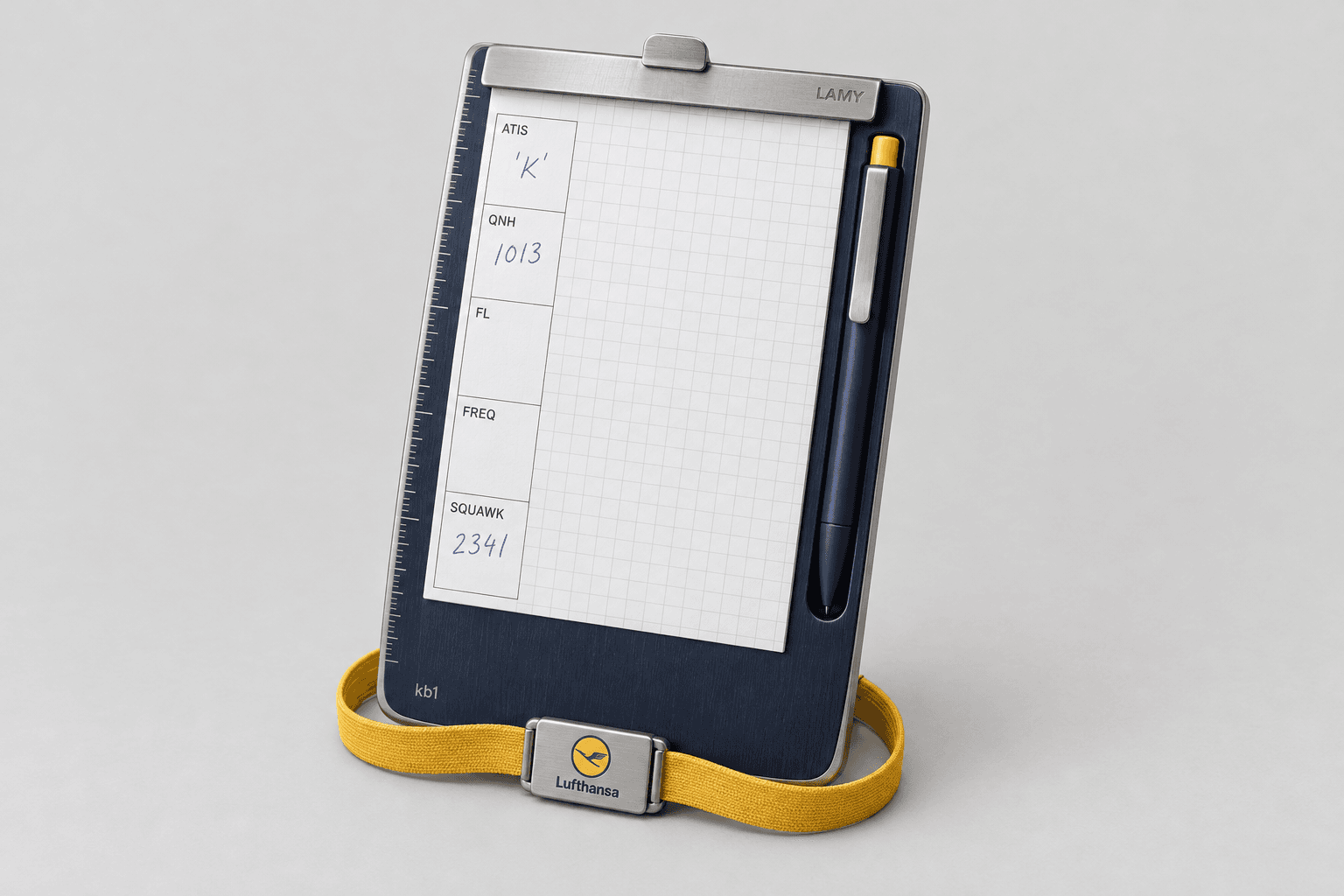
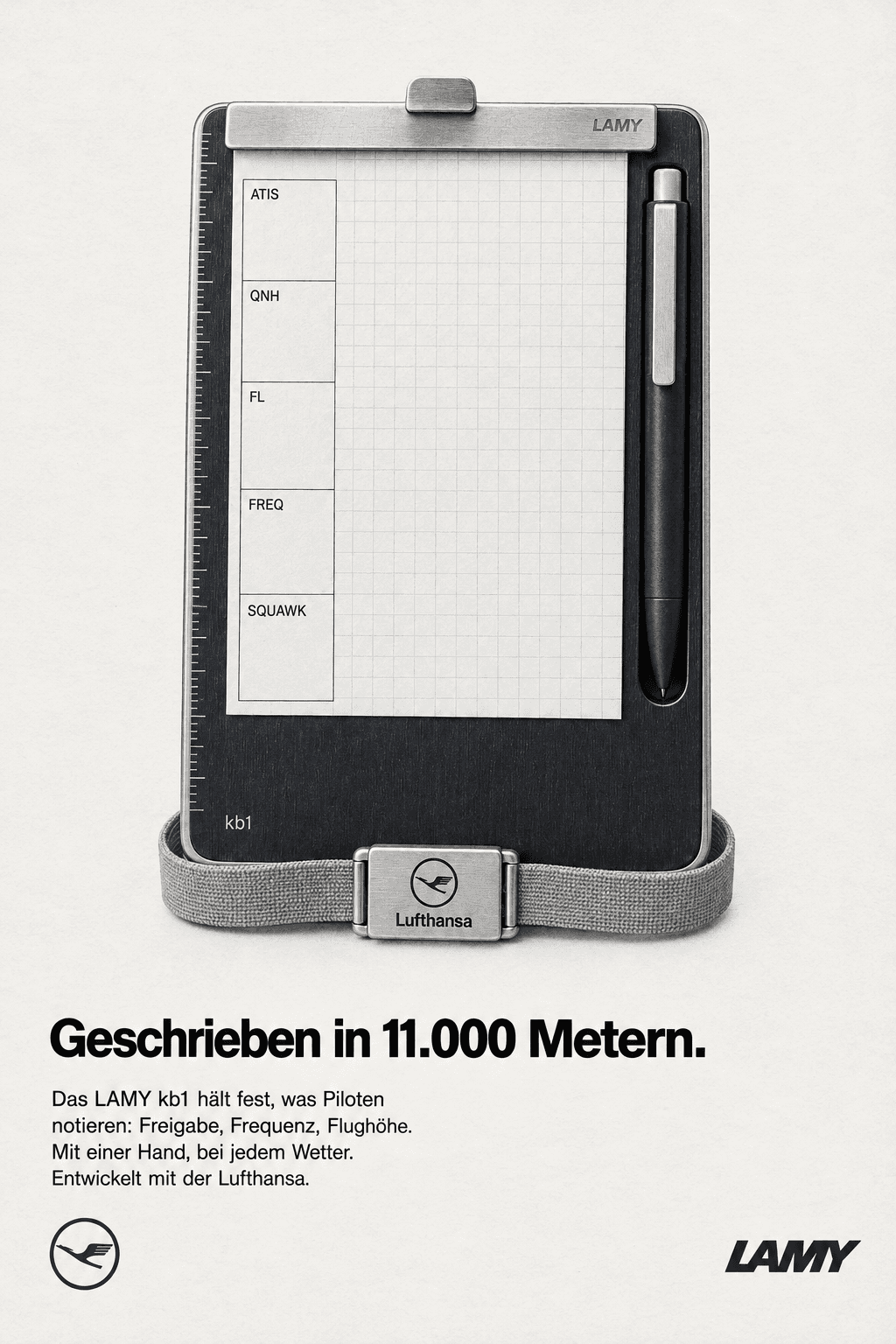
A clipboard that straps to your thigh, by the man who drew the Lamy 2000 and the man who put the Lufthansa crane in a circle, for writing a squawk code with one hand in turbulence.
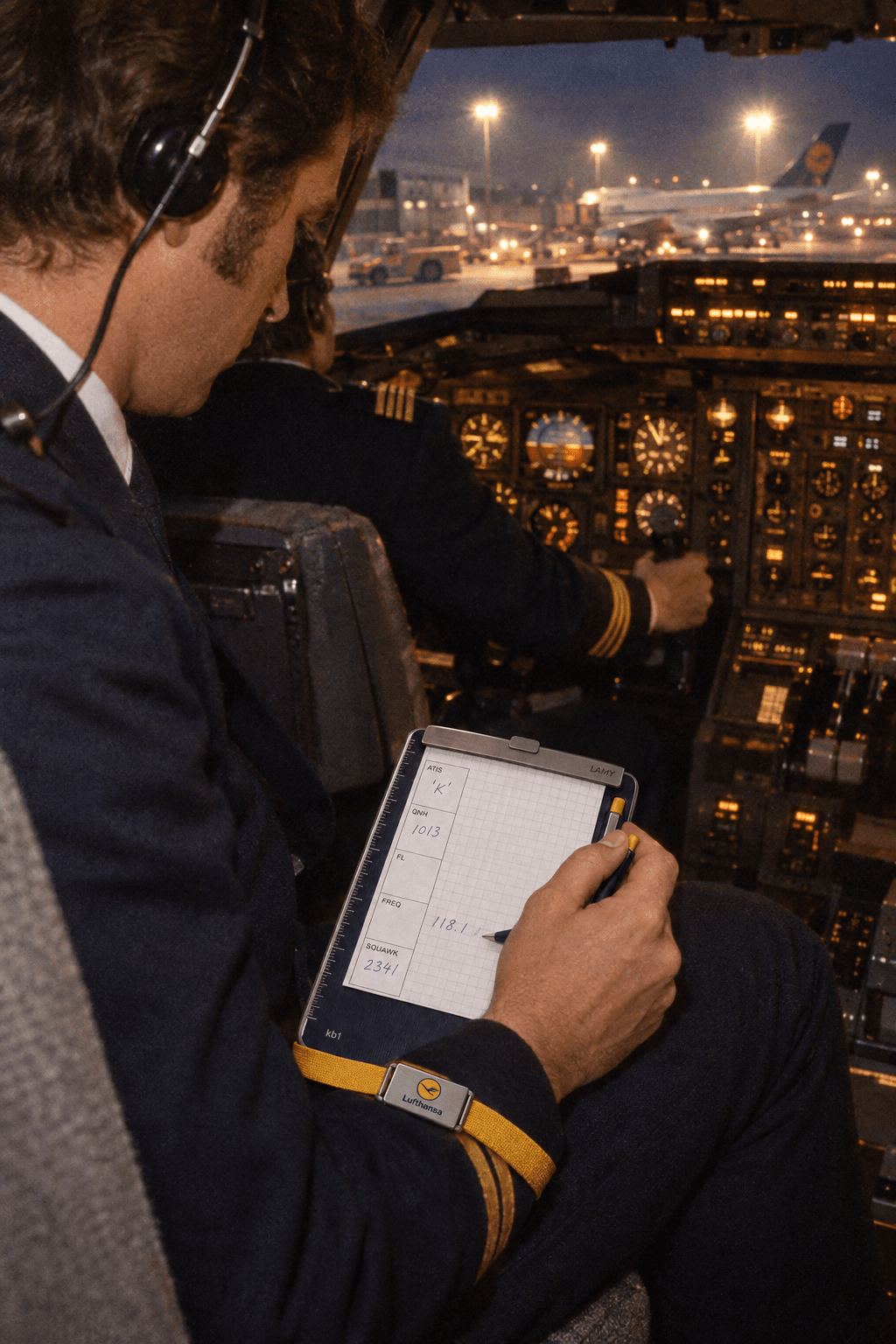
Announced September 18, 1973, at Lufthansa's flight operations building at Frankfurt airport, the LAMY kb1 began as a complaint. First officers on the new 747 fleet were copying clearances onto aluminium kneeboards ordered from American catalogues, with a pencil tied on by string. Lufthansa's flight operations department approached C. Josef Lamy GmbH in Heidelberg, which was releasing the cp1 and still had the Lamy 2000 tooling running. Otl Aicher, whose office had set the airline's visual system a decade earlier, was asked to do the printed face and ended up doing rather more.
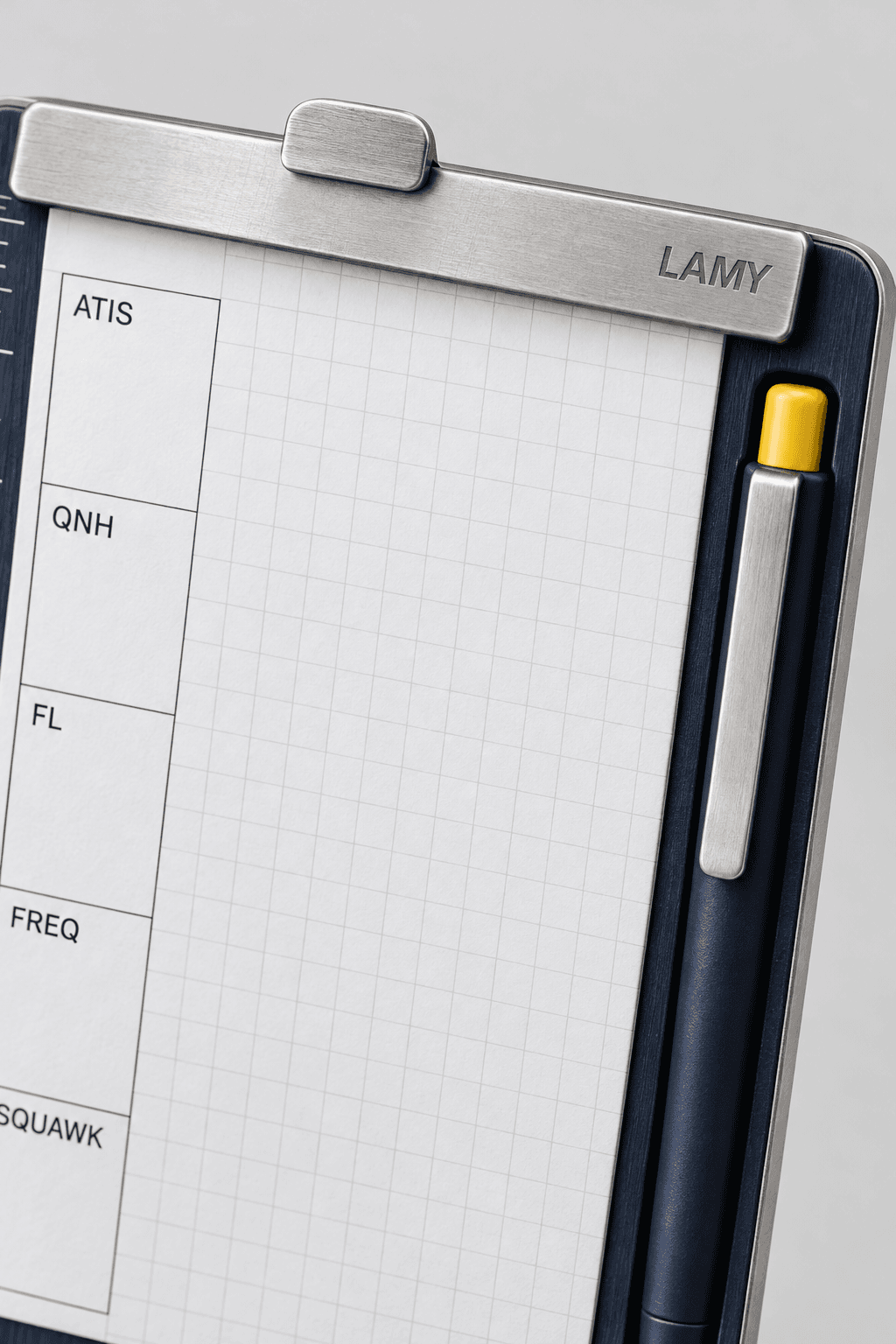
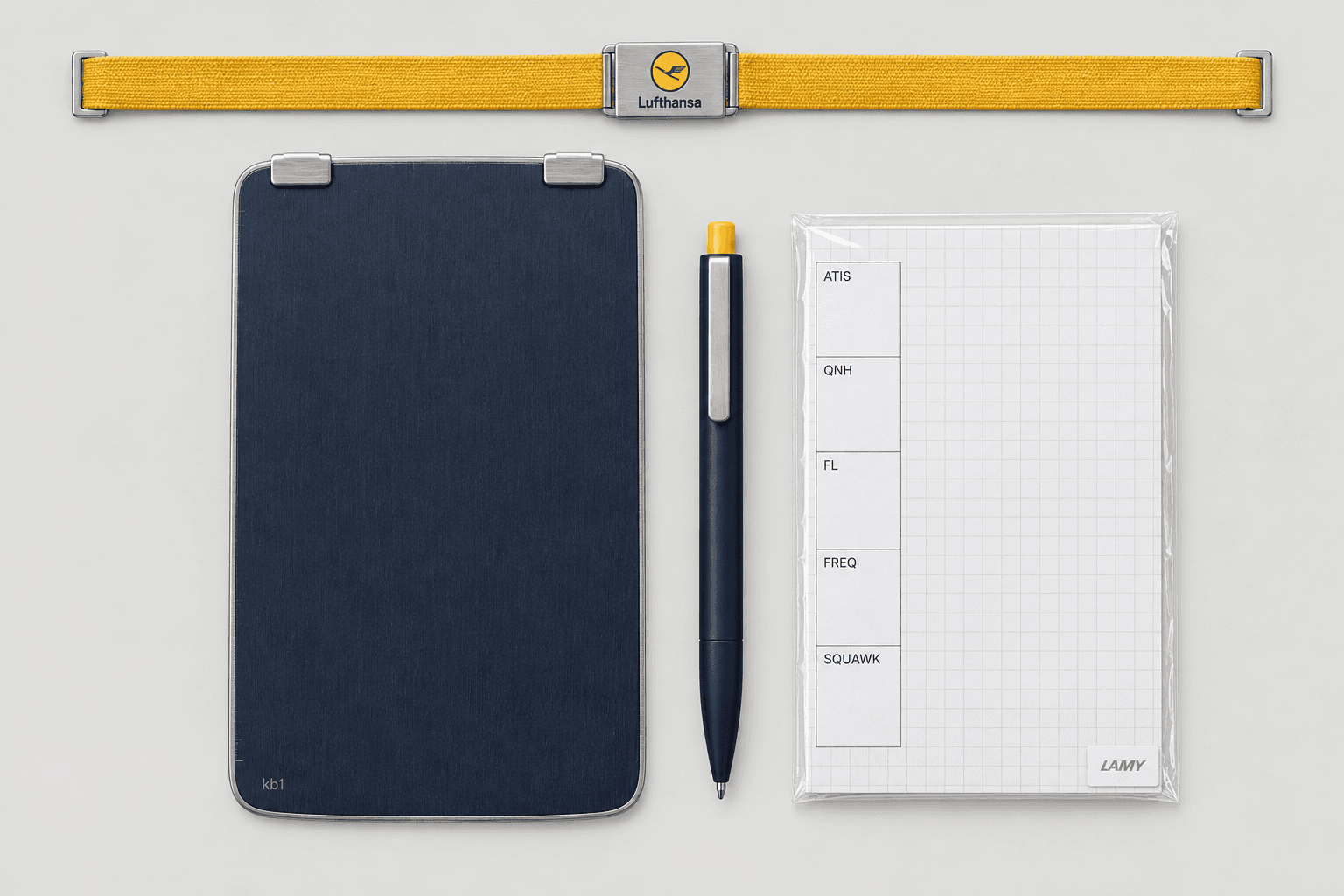
Aicher sent Müller a single sheet of 5 mm squared paper and asked that the board be drawn on it. It was: 240 by 170 mm is 48 by 34 squares, the pad is 30 by 40, and the clamp sits exactly two squares down. Müller kept to two materials. The face is the Lamy 2000's brushed Makrolon, dyed Lufthansa dark blue at Aicher's insistence, which made it the first Lamy in a colour. The brushing stops glare under cockpit floodlights and takes a chinagraph line when the pad runs out. The board curves along its length to a 420 mm radius, taken from plaster casts of the thighs of 38 trainees at the Lufthansa Verkehrsfliegerschule in Bremen.
The clamp is a Lamy 2000 clip scaled up: solid stainless steel, sprung, with a thumb tab you find without looking. The left edge of the steel frame is engraved with 5 mm ticks for measuring off a chart. The pad has five Helvetica boxes, ATIS, QNH, FL, FREQ and SQUAWK, stacked in the order a clearance is read out. Only the strap and the pen button are yellow, so the board can be pulled from a flight bag by feel and the pen clicked without looking down.
The first prototype held its pen with a ferrite magnet, which moved the 747's standby compass by four degrees and was quietly withdrawn. Müller replaced it with a sprung steel tongue taken from the Lamy 2000 clip, rated to hold the pen at 2.5 g after a test flight over the Alps in which a pen ended up behind the captain's rudder pedals. Crews took to it at once. The design magazine form was less sure and called it 'a clipboard with a pension'. The retail version sold through Lufthansa city offices and a few stationers, mostly to private pilots and architects.